Stock splits and dividends: what happens to your payout when a stock splits
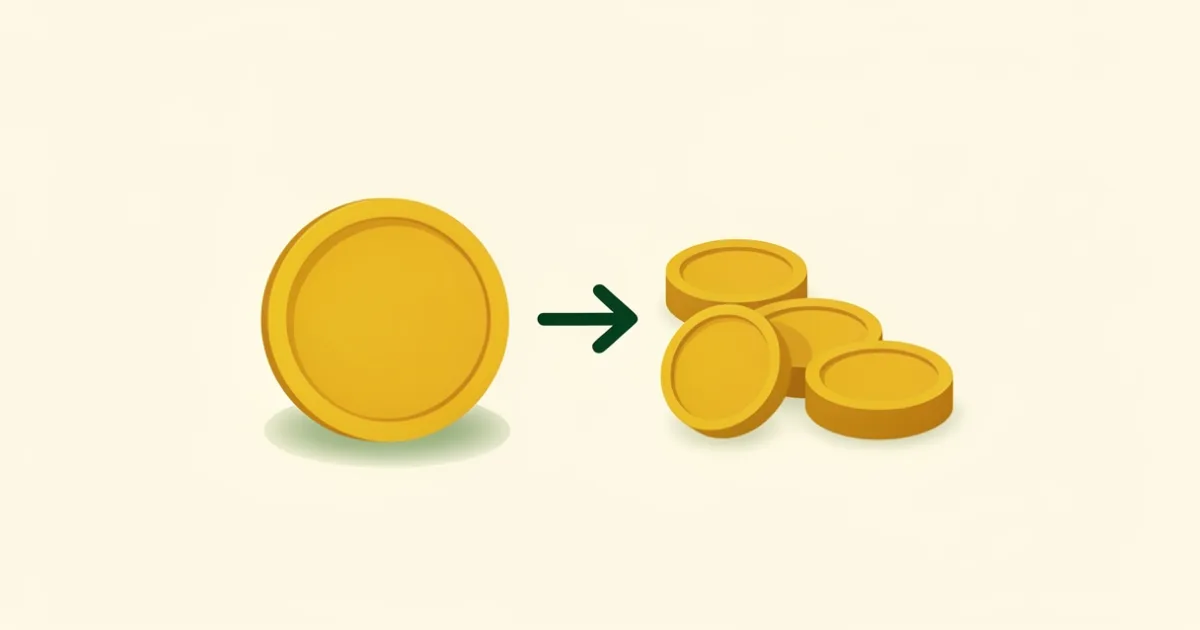
When a stock you own splits, three numbers change on your screen: you have more shares, each share costs less, and the dividend per share drops. The number that matters most, the cash you collect, stays the same. A split slices the same company into more pieces. It doesn’t make the company bigger or smaller, and it doesn’t change what you own.
A 4-for-1 split, worked through
Here is a made-up example to keep the arithmetic clean. You own 50 shares of a company trading at $400, paying $1.00 per share every quarter. The company announces a 4-for-1 split.
| Before the split | After the split | |
|---|---|---|
| Shares you own | 50 | 200 |
| Price per share | $400 | $100 |
| Value of your shares | $20,000 | $20,000 |
| Quarterly dividend per share | $1.00 | $0.25 |
| Your quarterly dividend | $50.00 | $50.00 |
| Dividend yield | 1.00% | 1.00% |
Every per-share number is divided by 4; every share count is multiplied by 4. Your value, your quarterly check and the yield don’t move. You can check the yield yourself in the Dividend Yield Calculator: $1.00 a year on a $100 share is the same 1% as $4.00 on a $400 share.
Why the dividend history can look like a cut
This is where splits confuse people. Some quote pages and spreadsheets list past dividends exactly as they were paid. After a split, the per-share amount falls off a cliff, and at a glance it looks like the company slashed its dividend. In this made-up example, the company raised its dividend from $0.96 to $1.00 a quarter and then split 4-for-1:
Nothing was cut. Each $1.00 paid before the split is worth $0.25 per share afterward, and the company is paying $0.25. Most data providers show “split-adjusted” history, which divides every pre-split dividend by the split ratio so the line stays level: $0.24, $0.24, $0.24, then $0.25 from the raise onward. If a dividend history shows a sudden drop, check whether the stock split around that date before you assume the worst.
The same goes for growth rates. A five-year dividend growth figure calculated from unadjusted numbers will be badly wrong. When you use the Dividend Growth Calculator, enter split-adjusted amounts for both the start and the end.
Reverse splits work the other way
In a reverse split, say 1-for-10, every ten shares become one. The share count falls, the price per share rises, and the dividend per share goes up by the same factor. Your total value and income are again unchanged on the day it happens.
Two practical differences. First, companies usually do reverse splits to lift a low share price, for example to stay above an exchange’s minimum price, so they tend to show up at struggling companies. That is a reason to look closer, not a verdict. Second, if your share count doesn’t divide evenly, the leftover fraction is usually paid out in cash, and that cash can be taxable.
Which shares get the next dividend
When a dividend and a split land close together, the company’s announcement says whether the dividend amount is per share before or after the split. Read that line rather than guessing. You end up with the same total either way, but the per-share figure on the announcement can look wrong if you read it against the other share count.
The split itself follows its own timing. Splits of 25% or more, which includes any 2-for-1 or larger, go ex after the new shares are distributed, not before, under the same FINRA rule that governs large special dividends. Your broker handles the new shares for you.
Taxes and cost basis
A regular stock split is not a taxable event. You don’t owe anything when the new shares arrive. What changes is your cost basis per share: the total you paid stays the same and gets spread over more shares. If you paid $20,000 for 50 shares ($400 each), after a 4-for-1 split your basis is still $20,000, now $100 a share across 200 shares. Brokers adjust this for you; it is still worth a glance at your cost basis page after a split.
If you reinvest dividends, fractional shares split too. A holding of 12.5 shares becomes 50 after a 4-for-1 split, and reinvestment carries on as before.
Does a split make a stock a better buy?
Not by itself. The company, its earnings and its dividend are exactly what they were the day before. A lower share price can make it easier to buy whole shares or add in small amounts, and many brokers now sell fractional shares, which makes even that less important than it used to be. If you are deciding whether a stock earns a place in your portfolio, look at the yield, the payout ratio and the dividend’s growth, all of which a split leaves alone.
Sources
This article explains how things work; it isn’t financial, tax or legal advice. Rules and figures are as of October 9, 2026. Check your own situation, or ask a professional, before you act on it.